
Spiritual Growth
Revelation Comes in a Moment. Renewal Comes in Reps.
Revelation Comes in a Moment. Renewal Comes in Reps.
.jpg)
Revelation Comes in a Moment. Renewal Comes in Reps.
What actually happens — in your soul and in your synapses — when you form a new thought and a new habit
You know the feeling. Something breaks open in a service, or in your reading, or at two in the morning when you finally stop arguing with God. A truth lands. You see the thing that has to change, and in that moment you are genuinely different. The desire is real. The decision is made.
And then you wake up the next day and the old response is just… sitting there. Waiting. As familiar and available as it ever was, like nothing happened at all.
If you've lived that, I want to tell you something up front: that's not weak faith. That is the exact place where two very different things part way — two things that both Scripture and neuroscience are careful to keep separate. Deliverance and formation. God can deliver you in a moment. But you still have to learn how to live delivered. One is a gift. The other is a process. And most of us get discouraged because we were promised the first and never told about the second.
So let's talk about the second. Let's talk about how a new thought actually becomes a new habit — sixty-three days, three cycles of twenty-one — and let's do it honestly, because a teaching is only as strong as its weakest claim.
About those "21 days"…
You've heard it a hundred times: it takes twenty-one days to form a habit. It's a great line. It's also not from neuroscience.
It traces back to a plastic surgeon named Maxwell Maltz, who noticed back in the 1960s that his patients seemed to need a minimum of about three weeks to get used to a change — a new face, a missing limb (Maltz, 1960). Somewhere along the way that cautious little "minimum of about" got sanded down into a hard rule it was never meant to be.
Here's what the research actually found when people stopped guessing and started measuring. A team at University College London tracked real people forming real habits and discovered the average time to make a behavior automatic was closer to sixty-six days — with a range that ran anywhere from about eighteen days to over two hundred, depending on the person and how hard the habit was (Lally et al., 2010). Simple stuff locked in fast. Hard stuff took months.
So no — sixty-three days is not some magic threshold where your brain chemistry clicks into place and you're free. It's a scaffold. It's a way of giving an invisible, slow-motion process a shape you can actually commit to, count down, and celebrate. And honestly? That's a better truth than the myth ever offered you, because it means this: you're not changed because sixty-three days went by. You're changed because you kept practicing the truth across those days. The calendar didn't do it. The reps did.
Which raises the obvious question — what are those reps actually doing to you?
Your brain is not a filing cabinet. It's a prediction machine.
We tend to picture the brain like storage — memories filed away, habits stored on a shelf. But that's not really how it works, and the real picture preaches a lot better.
First: repetition physically rewires you. There is a principle neuroscientists sum up as neurons that fire together wire together (Hebb, 1949). Every time a particular chain of thought and response runs, the connections that carry it get a little stronger. Run a pathway rarely and stay thin and effortful. Run it over and over and your body literally invests in it — reinforcing the connections and even wrapping the busiest circuits in myelin, a kind of insulation that lets the signal fly faster and cleaner (Fields, 2015). That's the actual, cellular meaning of something becoming "second nature." When you notice the new response getting easier, you are not imagining it — you are myelinating it.
Second: the controls move. When a behavior is brand new, it is run mostly by your prefrontal cortex — the deliberate, effortful, I have to remember to do this part of you. Keep repeating it, though, and control gradually shifts down to the basal ganglia, deeper machinery that bundles the whole practiced sequence into one automatic routine (Balleine & Dickinson, 1998; Graybiel, 2008). That is why a mature habit feels like it runs itself: because, neurologically, it now does. And here's the sobering part — that machinery is morally neutral. It will automate bitterness or gratitude with equal efficiency. It runs whatever you keep feeding it.
Third: your brain runs on prediction. Increasingly, scientists describe the brain not as a passive recorder but as a forecasting organ — constantly guessing what is coming next and firing off the response it expects to need before you have consciously decided anything (Clark, 2013). This is why triggers are so brutal. An old cue fires an old prediction, and the old behavior is halfway out the door before your willpower even shows up to work. So a huge part of formation is teaching your brain to predict differently — meeting the same old trigger with a new response enough times that the forecast itself finally changes.
Fourth: your chemistry locks it in. Dopamine — your brain's learning-and-motivation signal — does something fascinating as a habit matures. It stops firing mainly at the reward and starts firing at the cue that predicts the reward Schultz, 1998). The craving moves upstream. Meanwhile, the whole capacity to rewire depends on your body cooperating: proteins like BDNF that help new connections form and hold (Miranda et al., 2019), and consolidation that happens largely while you sleep —”neurogenesis” (Diekelmann & Born, 2010). Which quietly means formation isn't only a discipline of the will. It's stewardship of the body that carries the will — something worth sitting with if you care, as I do, about how the physical and the spiritual are never really separate.
Now hold all of that next to the language of the New Testament, because the overlap is almost uncanny.
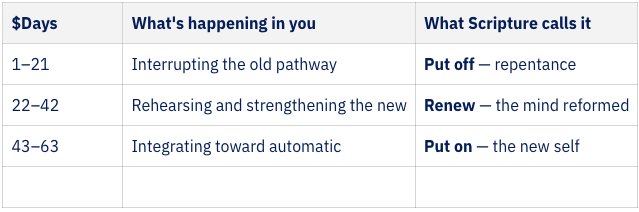
Cycle One (Days 1–21): Interruption
"I'm breaking agreement with the old."
Here is the mistake almost everyone makes in the first three weeks: they expect the new response to feel natural. It won't. It is deliberately not supposed to yet. This first stretch is not about the new thing feeling good. It's about refusing to keep rehearsing the old thing.
Your old pattern runs a loop, and it is predictable:
trigger → old interpretation → old feeling → old behavior
you are stepping in to break it, right at that second link.
trigger → truth → new response → new behavior
Remember the neurology: the old pathway is still a wide, well-paved highway, and the new one is a footpath through tall grass. Of course the old one feels easier. It has had years of traffic. Therefore, this cycle is not about gracefully walking the footpath; it's about refusing to keep paving the highway.
Scripture has a word for exactly this. This powerful word is metanoia — repentance — and it doesn't mean merely feeling bad. This means a change of mind that turns into a change of direction. A U-turn.
"Be transformed by the renewing of your mind." — Romans 12:2
This is the put off. And you are not allowed by the Spirit to skip it, because you cannot install a new pattern on top of an old one you are still secretly feeding. Similar to what Jesus meant when He said, “ You cannot pour new wine into old wineskins.” - Luke 5:37-39
Cycle Two (Days 22–42): Installation (Reconditioning)
"The Holy Spirit is teaching me another way to respond."
If the first cycle starves the old, the second one feeds the new, and this is precisely where most transformation quietly dies. People stop at "I'm just not going to do that anymore." And they mean it. However, the brain does not have vacuums. Pull out a deeply worn response without putting anything in its place, and the old pathway — still the strongest road you've got — simply takes back over the first time you're tired or cornered.
So this is repetition with a purpose: meet the same trigger with a different response, over and over, until your nervous system starts to catch on — the brain literally says, “Oh, this is how we do it now.” Every single rep is another thread of myelin on that footpath, another degree of prediction shifting, and another quiet handoff from effortful control toward automatic.
Listen to how precisely Paul has already mapped this:
"Put off… the old man… be renewed in the spirit of your mind… put on the new man." — Ephesians 4:22–24
Catch the order: put off, renew, and put on. There's a middle. Between stopping the old and becoming the new, there is renewal — the unglamorous, repeated labor of practicing the new thing before it feels like you. This is not a coincidence. It is the only honest description of how change works, written down two thousand years before anyone found the basal ganglia.
Line I'd underline here: transformation is not only starving at an old pattern; it’s repeatedly feeding a new one until your brain finally believes it.
Cycle Three (Days 43–63): Integration
"What took effort is starting to run on its own."
By the third cycle, the footpath is becoming a road. The controls have started migrating from I have to remember to do this toward this is just how I now respond. It costs less because it genuinely requires less effort — your physiology has finally caught up with your decision.
This is where the model turns a corner that habit science, all by itself, cannot get around. This is because Christian transformation was never merely a behavior modification. Behavior modification, at its very best, gives you a better-managed old self. Transformation gives you a new self.
"It is no longer I who live, but Christ lives in me." — Galatians 2:20 "If anyone is in Christ, he is a new creation." — 2 Corinthians 5:17
Automaticity, then, is just the servant of spiritual reality. The goal was never a well-trained old man who finally behaved himself — this would be trying to convert the flesh into the new man. The goal is a new person for whom the right response has quietly become native. This is the put on — and what you have practiced, you begin to actually inhabit.
If it helps to see the entire arc at a glance,
The Daniel 10 pattern: heard on day one, formed over twenty-one
There is one story that dignifies this whole tension, and it is worth slowing down and investigating deeper.
In Daniel 10, the prophet sinks into three straight weeks of prayer and mourning — twenty-one days. When the answer finally arrives, the messenger says something you can easily read right past:
"From the first day that you set your heart to understand… your words were heard… but the prince of the kingdom of Persia withstood me twenty-one days." — Daniel 10:12–13
Read it slowly. He was heard on day one. The answer was released immediately. However, its arrival came through a drawn-out, resisted process that took twenty-one days to break through.
Here is the entire doctrine of formation in a single narrative. The decision can happen in a moment; the formation happens through persistence. Heaven can move on day one while the breakthrough is still being fought for on the ground all the way to day twenty-one. And here's the sober part — if Daniel had quit on day fifteen, the answer already granted in heaven would simply never have landed in his life.
Now, I'm not going to tell you the Bible prescribes "three twenty-one-day cycles" as a formula. It doesn't, and we shouldn't build teaching on manufactured numerology. But the principle is deeply biblical: heaven answers decisively, and formation persists faithfully. Sixty-three days just gives that principle a shape you can hold in your hands.
One more thing, because it's the part people skip
Here is the piece that keeps this honest — and keeps it humble. Sixty-three days does not make anything permanent.
The old pathway has never been deleted. Even well-established patterns fade when you stop practicing them, and — this matters — old responses can come roaring back under stress and familiar cues. That is not a spiritual failure; that is, physiology. Under real pressure, your body's stress response actually biases you back toward automatic, habitual behavior and away from deliberate choices. The exhausted, cornered, and overly triggered version of you, as the Greek word "palaios" (meaning "old") that Paul uses in Ephesians 4:22 boldly states, is tired and worn out. This version of you will always reach for the oldest road available. This is exactly why a person who thought they were "done" is so blindsided to hear the old self answering the door in a hard season.
So, we have got to change the language. Not "sixty-three days makes it permanent in your neurochemistry." Try this instead: repeated practice over roughly two months can move a behavior from effort toward increasing automaticity — but what's formed still has to be maintained.
And would not you know it, that's better theology, too. It is why the New Testament does not talk about a one-time achievement but about abiding — remaining, staying, and continuing. Day sixty-three isn't a finish line. It's the point where you stop building the thing and start keeping it. Because what you do not maintain, you do not get to keep.
So here's the heart of it
Lay the two languages side by side and end up saying the same:
Revelation comes at a moment. Renewal comes in reps.
The first cycle interrupted the previous cycle. The second strengthens the new. The third lets what has been rehearsed and practiced settle in and become you. Transformation does not magically happen because 63 days clocked over — you are transformed because truth got rehearsed, again and again, across those days. What you keep rehearsing, you increasingly make your default. And what you stop rehearsing? You slowly hand back.
Which means the goal was never just to do a new thing for sixty-three days. The goal is to become someone who no longer even needs the old response — a new creation, put on and lived in, held up by grace and kept by practice.
God delivers you in a moment. Formation teaches you how to live there. The greatest deception of the enemy is that we can skip over interruption, and just begin by starting at installation and immediately have integration. Integration takes time because real heart transformation only comes by spending time in the presense of the Lord. You can’t discipline the flesh into new installation, you must totally interupt it.
You cannot discipline the flesh into new patterns; you must fully interrupt it. The greatest threat to change is not change itself, but the lie that a single rebuke will make the old ways vanish automatically. Deciding to interrupt does not guarantee the old will not try to return. Transformation is a process of persistent interruption and faithful rehearsal, anchored in grace and time spent in God’s presence—this is the true path to lasting change. His renewal is available in the moment, but real heart transformation comes in mirco-formations — the reps of life.
So let me encourage you. If today you feel as if you are back at square one, keep repping it out. Find that one thing that the Spirit is showing you, interrupt the old and keep creating the new. Don’t just complete one rep of repentance and expect the turnaround. You need to keep it at, rep it out, and stay consistent. Be consistent to apply yourself every day for the next 21 days. Of course, you cannot do it by your own strength, and this is where the Holy Spirit’s power will enable you. As you keep on applying yourself, something will shift in your neurochemistry, and a revelation will take place. Right now it does not feel normal, because it’s not supposed too. The first 21 days aren't necessarily about the new thing feeling natural. They are about refusing to keep rehearsing what was old.
One final word…new can't feel natural automatically, otherwise it isn't new. But new becomes the your new natural the more you make it part of who you are.
Key Statements
Transformation isn't only starving an old pattern; it is repeatedly feeding a new one.
God can deliver you in a moment, but you still have to learn how to live delivered.
Revelation happens in a moment. Renewal happens through repetition.
The first cycle interrupts the old. The second strengthens the new. The third integrates what you've been practicing.
Deliverance can break the chain, but discipleship retrains the pattern—God brings you out, and renewal teaches what He brought out of you how to live free.
Change the supply for 21 days, and you begin changing the appetite—because what you stop feeding weakens, and what you consistently feed grows stronger.
References:
Balleine, B. W., & Dickinson, A. (1998). Goal-directed instrumental action: Contingency and incentive learning and their cortical substrates. Neuropharmacology, 37(4–5), 407–419. https://doi.org/10.1016/S0028-3908(98)00033-1
Clark, A. (2013). Whatever next? Predictive brains, situated agents, and the future of cognitive science. Behavioral and Brain Sciences, 36(3), 181–204. https://doi.org/10.1017/S0140525X12000477
Diekelmann, S., & Born, J. (2010). The memory function of sleep. Nature Reviews Neuroscience, 11(2), 114–126. https://doi.org/10.1038/nrn2762
Fields, R. D. (2015). A new mechanism of nervous system plasticity: Activity-dependent myelination. Nature Reviews Neuroscience, 16(12), 756–767. https://doi.org/10.1038/nrn4023
Graybiel, A. M. (2008). Habits, rituals, and the evaluative brain. Annual Review of Neuroscience, 31, 359–387. https://doi.org/10.1146/annurev.neuro.29.051605.112851
Hebb, D. O. (1949). The organization of behavior: A neuropsychological theory. Wiley.
Lally, P., van Jaarsveld, C. H. M., Potts, H. W. W., & Wardle, J. (2010). How are habits formed: Modelling habit formation in the real world. European Journal of Social Psychology, 40(6), 998–1009. https://doi.org/10.1002/ejsp.674
Maltz, M. (1960). Psycho-cybernetics. Prentice-Hall.
Miranda, M., Morici, J. F., Zanoni, M. B., & Bekinschtein, P. (2019). Brain-derived neurotrophic factor: A key molecule for memory in the healthy and the pathological brain. Frontiers in Cellular Neuroscience, 13, Article 363. https://doi.org/10.3389/fncel.2019.00363
New King James Version Bible. (1982). Thomas Nelson.
Schultz, W. (1998). Predictive reward signal of dopamine neurons. Journal of Neurophysiology, 80(1), 1–27. https://doi.org/10.1152/jn.1998.80.1.1
Schwabe, L., & Wolf, O. T. (2009). Stress prompts habit behavior in humans. The Journal of Neuroscience, 29(22), 7191–7198. https://doi.org/10.1523/JNEUROSCI.0979-09.2009